

Professor Yoichiro Nambu wins the 2008 Nobel Prize in Physics
This year, the Nobel Prize in Physics has been awarded to three
Japanese physicists, Professor Yoichiro Nambu, Professor Makoto
Kobayashi and Professor Toshihide Maskawa.
Among them, Professor Nambu started his career at our Department
(1942: BA degree, 1942-1949: Research associate,
1952: degree of Doctor of Science) and has had a close association
with us since then.
The concept of "spontaneous symmetry breaking", which Professor Nambu
discovered, introduced a totally new method for giving mass to
fundamental particles and played a defining role in constructing the
"Standard Model" of elementary particles.
To date, many people have been awarded the Nobel Prize for their
contribution to this model.
We are very happy to know that Professor Nambu, whose work is the
basis of the "Standard Model", has finally been honored.
Professor Nambu's idea is quite universal in many branches of physics.
For example, superconductivity and rotational phenomena in quantum
systems can be clearly understood using his ideas.
The massless bosons which appear after the symmetry breaking are now
referred to as "Nambu bosons"
or "Nambu-Goldstone bosons".
We are indebted to Professor Nambu for his various contributions to
our Department. He provided opportunities to many researchers from
our Department to work in his Lab at the University of Chicago and
shared his great ideas with them. He also visited our Department
almost every year and shared with us his great inspiration through
beautiful lectures and seminars. He also gave us valuable suggestions
as a member of the independent review committee for the Department.
As an example, the goal of the 21st century COE program "Quantum Extreme
Systems and Their Symmetries" (2003-2007) was conceived in order to
promote a broad range of physics in a harmonious way, much like
Professor Nambu's work.
Congratulations Nambu sensei!

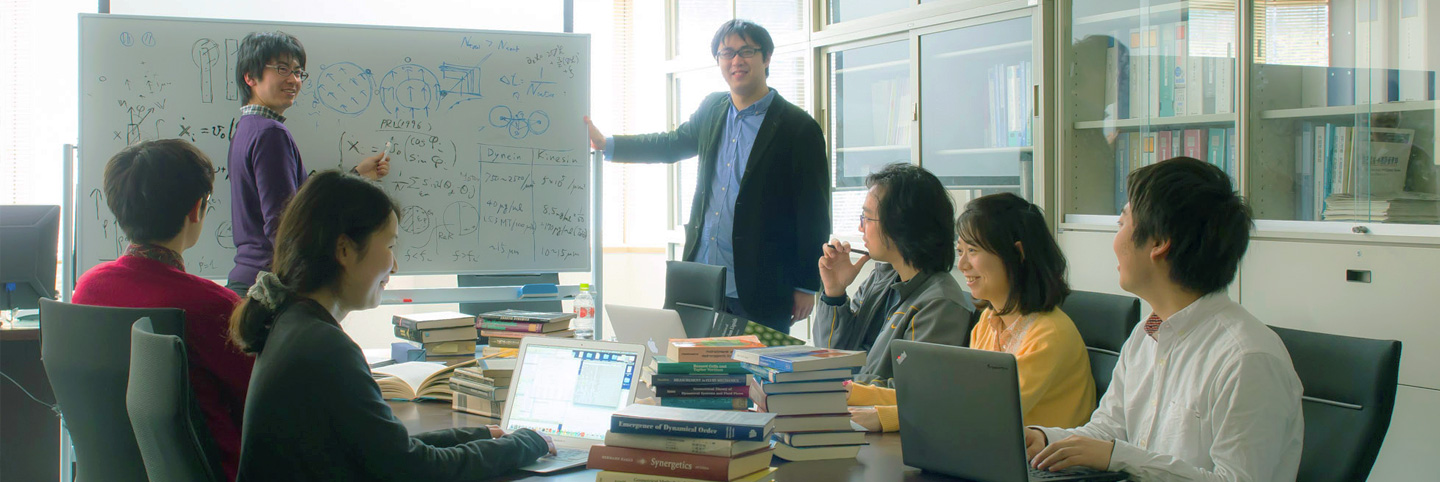
Photographs (Guidance and Get-Together for International Students:
Dec. 9, 2008)

Organization
The Graduate School of Physics consists of the Department of Physics (located at Hongo
campus) as the core institution,and also many collaborating independent laboratories.
In total, there are more than 130 senior faculties who can supervise graduate students.
The organization link shows these collaborating Labs in a glance.
Faculty members
A list of the senior faculties of Department of Physics and those from collaborating Labs.
Links to Labs
A List of the links to the laboratories of Department of Physics.
Personnel & Jobinformation
Recruiting information of Department of Physics.
Annual report
Summary of the academic activities of the members of Department of Physics.
Access
How to come to Department of Physics in Hongo campus.